
Food & Beverage
Food & Beverage Filling Solutions
Food and beverage products vary widely in their filling requirements—from coconut water, juice, and other low-viscosity beverages to honey, sauces, jams, and foods containing particulates. Differences in viscosity, flow behavior, particulate content, hygiene requirements, and packaging format all influence the choice of filling method, product-contact materials, cleaning procedures, and equipment configuration.
For example:- Beverages: High-speed filling, consistent fill levels, and foam control are often important.
- Sauces and honey: Higher viscosity calls for stable product transfer and accurate dosing.
- Foods containing particulates: The filling system needs to handle small solids without clogging while maintaining the product's characteristics.
Because these products behave differently during filling, equipment should be selected according to the product characteristics and packaging requirements rather than relying on a single filling method for every application.
Npack designs and manufactures fully automatic liquid filling equipment and packaging systems for food and beverage applications. The filling solutions can be configured for bottles, jars, and other packaging requirements, with filling, capping, labeling, and conveying systems integrated according to the product and production needs.
Piston filling uses reciprocating piston movement for volumetric dosing. It is particularly suitable for sauces, honey, jams, pastes, and other medium- to high-viscosity foods, and can also handle products containing small particulates.
A stainless steel rotary lobe pump provides stable transfer of high-viscosity liquids, pastes, and products containing particulates. Servo motor control allows precise flow adjustment for consistent filling, making this method suitable for products such as sauces and condiments.
Overflow filling is well suited to beverages, juices, and other low- to medium-viscosity products where a consistent fill level is important, particularly in transparent bottles. Excess liquid is returned during filling to maintain a uniform liquid level from bottle to bottle.
With servo drive and synchronized tracking, the filling nozzles move with the bottles while dispensing. This allows filling to take place without stopping bottle movement and is suitable for medium- to high-viscosity liquids and pastes such as honey and sauces.
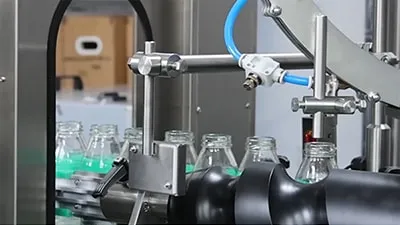
- Product: juice
- Filling nozzles: 10
- Filling method: piston filling
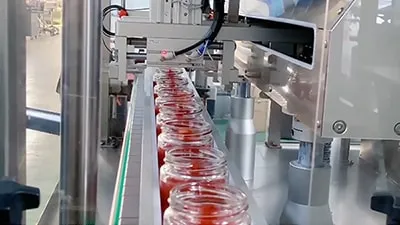
- product: tomato sauce
- filling nozzles: 2–4
- filling method: piston filling
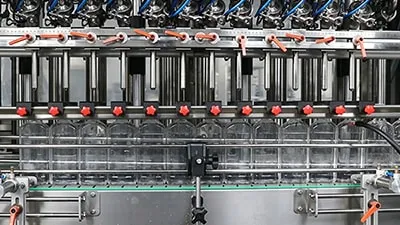
- Product: wine
- Filling nozzles: 12
- Filling method: piston filling
Some beverages, including juice and dairy beverages, can generate foam during high-speed filling, which may affect filling accuracy, fill-level consistency, and subsequent capping.
Depending on the product, Npack can help reduce foaming by adjusting the filling speed, optimizing the nozzle design, and using bottom-up filling to reduce liquid impact during dispensing. For products where a consistent fill level is especially important, an appropriate overflow filling system can also be used to maintain a uniform liquid level. The final configuration should be selected according to the beverage’s viscosity, foaming characteristics, bottle format, and required production speed.
All product-contact parts are specified as 316 stainless steel. These components feature a sanitary design with mirror-polished internal surfaces to help reduce product residue and simplify cleaning and routine maintenance. Food-grade seals and tubing can also be configured according to the characteristics of the product.
The appropriate cleaning method depends on the product, hygiene requirements, and equipment configuration.
Npack filling equipment is designed for convenient cleaning and maintenance and can be configured for CIP (Clean-in-Place) where required. This allows product-contact areas to be cleaned through circulation, reducing the amount of disassembly required during cleaning.
A typical cleaning procedure includes:
- Drain residual product from the hopper and piping
- Rinse with warm water
- Circulate a food-grade cleaning agent
- Rinse with clean water
- Drain any remaining liquid