
Industrial & Edible Oil
Industrial & Edible Oil Filling Solutions
Oil products vary widely in their filling requirements, from edible oils to lubricating oil, hydraulic oil, and engine oil. Differences in viscosity, flow behavior, foaming tendency, density, and chemical compatibility all affect the choice of filling method, metering system, product-contact materials, and sealing configuration.
Packaging can also range from bottles and plastic pails to drums. A system configured for a low-viscosity edible oil may not be suitable for a higher-viscosity industrial lubricant, so the filling technology and equipment setup should be matched to the product characteristics, package size, and production requirements.
Npack designs and manufactures fully automatic liquid filling equipment and packaging systems for edible oils, lubricants, and other industrial oils. Equipment can be configured for bottles, plastic pails, and other containers, with filling, capping, labeling, and conveying systems integrated according to the application.
Piston filling can handle low- to high-viscosity oils, including edible oil, lubricating oil, and hydraulic oil. It provides accurate volumetric filling and is suitable for package sizes from 100 ml to 6,000 ml.
Gear pump filling provides stable product transfer and accurate dosing for products such as lubricating oil and edible oil. It can accommodate oils with different viscosities, making it a versatile option for both industrial and edible oil applications.
Net weight filling controls the fill quantity by weight and is suitable for 10–300 L packages of oil and other industrial liquids where accurate dosing is required.
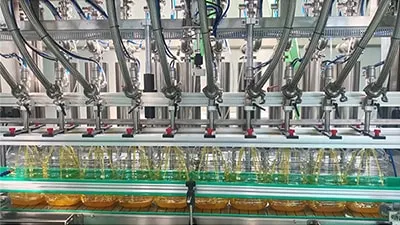
- Product: edible oil
- Filling nozzles: 10
- Filling method: piston filling
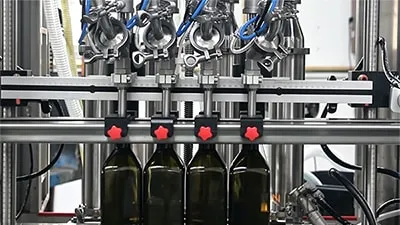
- Product: olive oil
- Filling nozzles: 4
- Filling method: piston filling
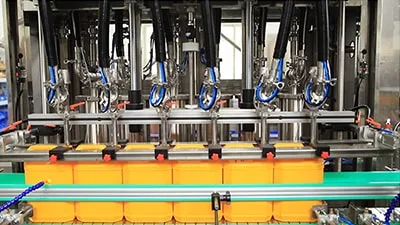
- Product: lube oil
- Filling nozzles: 6
- Filling method: piston filling
Npack filling equipment can use an anti-drip and suction-back system to reduce residual liquid dripping from the nozzle after filling. At the end of the filling cycle, a small amount of liquid remaining at the nozzle tip is drawn back to help prevent the final drop from falling onto the container. Depending on the oil viscosity and packaging requirements, bottom-up filling and anti-drip valves can also be used to support a cleaner, more stable filling process.
The filling method and equipment configuration should be selected according to the product characteristics and production requirements to achieve the required filling accuracy and production efficiency. Key factors include:
- Oil type, such as edible oil, lubricating oil, or industrial oil
- Product viscosity
- Filling volume
- Required production speed
- Bottle type and package specifications
- Automation requirements
A filling machine can be adjusted for various oil products, but not all oils are compatible with the same configuration. Differences in viscosity, density, lubricity, behavior under temperature changes, and hygiene requirements may require different pump types, product-contact materials, filling nozzle designs, and control settings.